A Closer Look at the Google Nexus S by Samsung If you're coming from a Samsung Vibrant or Captivate, you'll notice a few things have been tweaked. The micro USB port is finally at the bottom where it belongs, and there's no tiny sliding cover over that port. At first I loved that little sliding cover, but after using the Vibrant and Captivate for several months, I found I never remembered to slide it closed anyhow. The headphone jack is at the bottom rather than top on the Nexus S (I'm neutral on that one) and the phone is a wee bit thicker and less tapered on the sides vs. the Vibrant. That's a wonderful thing because the Vibrant, much like the iPhone 3GS and iPod Touch, is too thin to easily pull out of a pocket or bag and next to impossible to hold onto. The Nexus S feels much better in hand. The exaggerated (compared to the Vibrant) rear chin also makes it easier to grip the phone and feels good in hand. That chin also creates an overall level rear cover that prevents wobble when laying on a desk. The phone is unabashedly gloss black plastic-- something that Samsung and perhaps folks in the Far East love much more than Americans. I have nothing against the look other than the fact it gets embarrassingly grimy looking. The phone does not look cheap. In fact, the updated lines and blacked out look are downright sexy and classy. But I do miss HTC's metal and professional look in the Nexus One. Those plastics mean the Galaxy S weighs less than the Nexus One even though it's a little bit larger. It feels solid enough in hand, and it's no more delicate than the Vibrant and overseas Galaxy S sold in Europe and Asia. As with other Samsung high end Android and Bada OS phones, the back cover has a subtle pattern that's visible when you move the phone back and forth in the light. This is not a tactile pattern, it's purely eye candy. 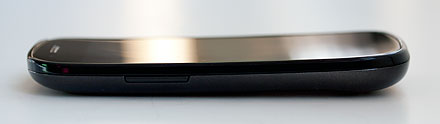 The power and volume controls are in the same locations as the Galaxy S (near the top on the right and left sides), and that means they're too easy to squeeze when pulling the phone out of a pocket or purse. It's also hard to avoid hitting the top volume control when pressing the power/wake button. The touch sensitive front Android buttons are the usual faintly masked ones that are much easier to see when their backlighting is on. The button order is different from the Galaxy S phones... so much for muscle memory. They are the usual Android buttons for back, menu, search and home. Alas, there's no dedicated camera button, and that means you need a steady hand when tapping the on-screen focus/shutter button. The display is as beautiful and vivid as ever. Nothing beats Samsung's super-sized 4" Super AMOLED display for brightness, color saturation and outdoor visibility. Though the respectable 235ppi pixel density is lower than Apple's iPhone 4 Retina Display, I have no complaints about text clarity and image sharpness. The touch screen supports multi-touch pinch zooming and is very responsive. Performance is top notch. Froyo's claim to fame was significantly improved speed, and Gingerbread takes it a bit farther. The Nexus S is a very fast phone and it flies through high quality MPEG4 video playback, YouTube streaming in HQ over 3G and WiFi and it handles native Flash better than many other Flash-capable Android handsets. From the benchmarks below we see that the Nexus S is one of the faster Android smartphones on the market according to Quadrant whose tests include 3D trials. Softweg does 2D graphics only, and the Nexus S scores well overall there too. It will be interesting to see how the Nexus S does when rooted and overclocked (the Hummingbird can be a bit sensitive to overclocking) and with custom ROMs. Benchmarks: Softweg benchmark: Graphics: 31.7 CPU: 1680 Memory: 679.7 File system: 271.65 Quadrant: 1648 Video Review Here's our video review of the Google Nexus S: Phone and Data The Nexus S has excellent call quality and solid reception. While the db sometimes reads higher on our Vibrant for reception, the Nexus S never dropped down to EDGE during a call unlike the Vibrant and T-Mobile G2. The Vibrant, like all Galaxy S phones, has good voice quality, but the Nexus S beats it with extremely clear incoming and outgoing audio with good volume. Bluetooth behaved well, and again I thought the Vibrant sounded quite good with my BMW Bluetooth, but the Nexus S took it up a notch with even louder, more full and natural audio over the car's speaker system. Call recipients said we sounded close to landline good with adequate noise reduction. The Nexus S is a quad band GSM world phone with EDGE and it's sold unlocked for use with any GSM carrier (T-Mobile and AT&T in the US). The Nexus works best with T-Mobile in the US, since it has their 3G bands. It also has overseas 3G on the 900/2100MHz bands, making it a capable world traveler. We recommend the Nexus S if you're a T-Mobile US customer: not only can you get contract pricing, but you get 3G. On AT&T you'll get EDGE and Google phones aren't much fun on EDGE since they're data-centric. If you're a Sprint or Verizon customer, you're out of luck since those carriers use CDMA rather than GSM networks. GPS and Camera Samsung's issues with the Vibrant and Captivate GPS mean that we have to test the heck out of their Android phones. So far, the Nexus S' GPS has behaved well. Cold fixes (just after a reboot when indoors) are slower than average at 8-10 seconds but once the device gets a fix, it holds onto it and positions us accurately. We'll keep testing this over the coming weeks since the Galaxy S' GPS issues didn't always show up immediately. The phone works with Google Maps, Navigation and other location-based services and it has a digital compass that's handy for walking directions. Google Maps, now up to version 5, has come a long way quickly and directions are generally spot-on and in some cases better than the gold standard, TeleNav. Google Maps, unlike TeleNav and VZ Navigator, now knows about multiple entrances to large venues and big box stores, and that means it no longer tells you to circle around the block until you reach the sanctioned entrance. 3D moving maps with illustrated landmarks are new for version 5 and we find the 3D view much easier to follow when driving. The Nexus S has a loud and clear speaker, much like the Galaxy S phones. We had no trouble hearing it in the car, and it's downright loud indoors. The 5 megapixel camera takes very good shots with strong, generally accurate colors, plenty of detail and sharpness that's pleasing without looking overdone. Samsung's higher end phones tend to have good cameras and the Nexus S certainly takes as good photos as do Samsung Galaxy S phones, if not better. Image quality is far superior to that of the Nexus One. Our only complaint is the lack of a hardware shutter button since it's hard to hold the phone still when poking the on-screen capture button.  Sample 5MP photo. Click on the image to see a larger version. There are plenty of settings to tweak captured photos, and a simple slider to switch to video recording mode. The Nexus S is limited to 720 x 480 pixel video, but video quality is quite good. We do wonder why the Vibrant gets 720p video while the Nexus doesn't. The front-facing camera is a plus for those of you who want to video-chat. The camera application can control either camera, but there's no built-in software for video chatting. We downloaded Tango and at first it worked with the front camera, but after the first 2 uses, we couldn't get it to use the front camera again (the rear one works well). We downloaded Qik via the T-Mobile tab in the Android Market, but it crashed when we tried to do 2-way video calling. Clearly, it will take some time to get the Nexus S up and running with video calling, and the newly added SIP support in Gingerbread may be part of the problem. And speaking of the T-Mobile tab in the Android Market, you only see it if you're using a T-Mobile SIM. Battery Life Battery life is the big hurt for the Vibrant, and mine lasts only a day with moderate to not quite heavy use. The Nexus S in contrast, has been hard to kill. We'll continue to test battery life over the coming weeks, but so far the Nexus S has no trouble lasting through a day with heavy use that includes calls, push email, Twitter updates, newsfeed updates and the usual Google data syncing. The 1500 mAh Lithium Ion battery is the same capacity as the Vibrant's, but it's a different physical design so they're not interchangeable. Conclusion The Samsung Nexus S Google phone isn't for everyone. Here in the US it's a solid choice on T-Mobile, but I'd pass for use on AT&T since it lacks AT&T's 3G bands. We expect support and hardware exchanges to be much smoother vs. the Nexus One since Best Buy and Samsung are backing the phone, while the Nexus had virtually no customer service support from Google, little support from HTC and no retailer to act as middleman. The hardware is top notch even if not groundbreaking, and the phone's biggest selling points are getting Android OS 2.3 Gingerbread early, and the pure Google Android experience. The phone is very fast, stable and is a clean slate with no added manufacturer or carrier bloatware. We're big on losing the bloat and problems it can cause, though admittedly, Google's media players are weak and could use a little Samsung love. If you're looking for the latest in Android, want a clean experience and more timely OS and application updates, the Samsung Nexus S is your best bet. Should you replace your Vibrant on T-Mobile? I've done so for the new OS (nearly a requirement for my job as a reviewer), and cleaner and more stable software. The Nexus S just works, and that's a good thing after living with the Galaxy S' various quirks. Is it a groundbreaking device as the Nexus One was in its day? No. Price: $199 with a T-Mobile US contract, $529 without contract Website: www.google.com/nexus |
Specs:
| Display: 4", 800 x 480 capacitive multi-touch Super AMOLED display (curved Contour display) with 235ppi pixel density. Has accelerometer, proximity sensor and ambient light sensor. Has haptic feedback and 3-axis gyroscope. Battery: Lithium Ion rechargeable. Battery is user replaceable. 1500 mAh. Claimed 3G talk time: 6.7 hours. Claimed standby: up to 17.8 days. Performance: 1GHz Hummingbird CPU (ARM Cortex-A8) with POWERVR graphics. 512 megs RAM and 16 gigs iNAND flash storage with approx. 13.5 gigs available. Size: 4.87 x 2.48 x 0.43 inches. Weight: 4.55 ounces. Phone: GSM quad band world phone with EDGE 850/900/1800/1900MHz. 3G HSDPA 7.2Mbps/HSUPA on the 900/1700/2100MHz bands (compatible with T-Mobile US and overseas). Has Google's WiFi Hotspot feature for sharing 3D connection over WiFi with laptops and other devices. GPS: Has GPS with aGPS and digital compass. Camera: Main (rear) 5.0 megapixel with autofocus lens and LED flash. Can shoot HD 720 x 480 video. Front camera: VGA camera for video conferencing etcetera. Audio: Built in speaker, mic and 3.5mm standard stereo headphone jack. Networking: Integrated WiFi 802.11b/g/n and Bluetooth 2.1 +EDR. Software: Android OS 2.3 Gingerbread. Standard Google apps including the Android Market, Google Maps with Navigation, Google Earth, Google Talk, Google Search, Google Voice, Google Talk, Gmail, Email, Voice Actions and YouTube player. Expansion: None. NFC: Yes. In the Box: Phone, battery, USB cable, world charger and stereo earbud headset. |


Tidak ada komentar:
Posting Komentar